Sunday, 19 July 2015

Things that make the Aesthete go rrnnngahh!

The Aesthete's Fleet
The GTV is at the paint shop now having had its wheel arch fixed in a surgical procedure they use on the TV show Botched to repair bad nose jobs. Large amounts of cosmetic filler were removed from the site and delicate tools and hammers used to reshape the profile into its correct Roman proportions. As my mother used to say about my own prominent honk,  "You have a Roman nose darling. It roams all over your face".


1962 Humber 80 Estate. Well, how many of these have you seen? This smart Humber 80 must be close to unique given that the brand name was only used here to capitalise on the Humber limousines that ferried various visiting regal personages and governors general around their little allotment in the South Pacific. It is just the sort of thing I imagine Betty Windsor would take to the grouse shoot and therefore much too good for anyone reading this blog.

For: For God's sake man, stand up straight and take your hat off.
Against: Nothing. Are you some sort of socialist?
Investment potential: 12/10.


1956 Triumph TR3. The obsession with 'barn finds' does not seem to have struck here in quite the frenzied way it has in other markets. This is because we are not at all surprised to see sports car wrecks in sheds in Balclutha, somehow knowing that is their natural habitat. This rough looking TR has been the victim of an amateur scratch over but little else seems to have disturbed its integrity. I would be tempted to brush paint it in red oxide roof paint and use it as it is.

For: The epitome of the trad British roadster.
Against: Imagine driving the Marquis de Sade's rack on a dirt road.
Investment potential: 10/10


1987 Porsche 944 Turbo. 12.5K to be able to travel at 260KPH is a cost to performance ratio that cannot be ignored by the savvy purchaser. This fact is pushing values up very slowly but the market seems to prefer virginal examples cosseted by Japanese motorists who have only driven them in Yokohama traffic jams. You may be able to do it in a twenty year old Toyota Supra but the Aesthete is washing his hair that day and will be unable to join you.

For: High miles but treated properly.
Against: Please let it not be a bag of Neckarsulm bolts.
Investment potential: Using the cos/perf ratio 9/10


1975 Triumph Dolomite Sprint. The Sprint version of Triumph's luxurious small saloon is another neglected gem produced in the senile fog of the 1970s British motor industry. Treated to a four valve head compromised by a single camshaft producing identical timing for both inlet and exhaust, the Sprint nonetheless gave trouble to BMW 2002s and Alfa GTAs, both of which now sell for an absolute fortune.

For: The vendor seems helpful.
Against: Ask him some questions but don't excite him.
Investment potential: Compared to a GTA, 47/10. In reality 8/10


1974 Fiat 128. Further evidence that Italy should have been the only nation in the world to be allowed to manufacture small family cars in the 1970s is this Fiat 128. So utterly superior to anything else, the driver could forget that they were driving in a child's drawing of a car and pretend it was a club racer. I was once driven around Birkenhead in one by Eric Brook, a car dealer who could have been played by Alec Guinness in a dramatisation of his life. Even though he had it on two wheels, I have never felt safer.

For: The best 128 in New Zealand, or perhaps the RHD world. I would doubt that there are 10 in the whole of the UK.
Against: I have said all I will say on this matter.
Investment potential: Quickly, get it in a container and off to Blighty. 23/10

On some faraway beach...


1952 Simca 8 Sport. The reader who occasionally corrects my spelling of Italian proper names will be busy with this listing that renders them phonetically as heard by a Floridan. I think he means to infer that this lovely Pininfarina Simca looks like an early Ferrari which it does. Simcas of this period were rather close to their Fiat forebears so this is indeed an inexpensive way to the concourse circuit, if that is what turns your crank.

For: If it was a Cisitalia it would be more than you could afford.
Against: Well, it's not, is it?
Investment potential: Simple to restore and potentially valuable. 9/10


Sunday, 12 July 2015

The Aesthete relapses

The Aesthete's Fleet
I could not help noticing that the address to which I delivered the Lancia was dotted with Alfetta GTV wrecks so I have made an offer on one with the intention of scavenging its gearbox and sundry bits and pieces. Costs mount up even when buying second hand so a spares car makes sense although its flayed corpse will go to the crusher as soon as I am done with it. I cannot be lowering the tone of the neighbourhood by filling the driveway with hulks, even if they are highly desirable Italian classics. As it is, the Aesthetette is doing her bit by driving into cars at random. She: "I have hit the Alfa" He: "Which one?" So there is the problem laid bare.


1974 Citroen DS23 Safari. I am surprised Wonderboy has not got the trailer hitched up behind his Porsche and speeding northwards now. DS23s are unusual enough but there must only be a handful of Safaris in this the penultimate DS specification. There is not a lot of useful information on the listing and the vendor does mention rust issues but what can be seen looks tidy enough apart from the damaged rear wing. Go forth Francophiles and hie thee to Levin before someone snaps this up.

For: C'est formidable!
Against: Fifteen years laid up could spell trouble.
Investment potential: 6/10. No matter what is wrong with it, the price is right.


1974 Rover 3500S. Cuba was a triumph of western economic planning compared to Solihul in the 1970s. Despite Jaguar being in the next village, no manual gearbox could be found to withstand the torque of the V8 even in mild tune so the five speed conversion is a welcome modification. The interior is looking a bit sad but there are enough of these sitting around under trees for better  seats to be a fairly straightforward matter. If you were feeling suitably bold you could take the resto-mod path and liven things up even more.

For: These are fun with a proper gearbox.
Against: The rest of the mechanicals may need a once over.
Investment potential. Oh, come on. Its 2K.


1937 BSA 10. The Aesthetette's Brummie dad decided that I was fit to marry his daughter when I answered correctly that BSA stood for Birmingham Small Arms. This cumbersome industrial combine also included Daimler and Lanchester so the BSA was effectively a midget Daimler and very well engineered for a car in the 10hp class. The range was typically bewildering with both front and rear wheel drive versions produced in this model year. This appears to be a 10 rather than a Scout but charming in any case.

For: A toff's 10hp.
Against: Make sure you find all the bits. There are not many of these left.
Investment potential: 2/10 and where is the interior may I ask?


1955 Mercury Montclair Sun Valley. The Alfa Brera's glass roof made people look twice ten years ago but the idea goes back to old Henry Ford's experiments with plastics in the 1930s. The Sun Valley option on Mercury's top coupe was tinted glass rather than perspex but there were few takers when a drive in the summer sun led to heat prostration and the potential for driving your new pride and joy into the rear of a semi trailer.

For: The ideal car for Dunedin.
Against: A lot to pay for a failed gimmick.
Investment potential: 2/10 but rarity counts for something.


1961 Skoda Felicia. Bob the Bi-spiderman spotted this last week and told me to look out for it. The Felicia must have brightened up 1950s Prague and you could imagine the city's bright young things feeling happy that they had a domestic product that did not look like it had been designed by slave labour. This one has some dints that detract from the almost Alfa like rear end but those rear quarter bumpers give the Aesthete a pleasant tingle.

For: Fun, fun, fun until her daddy took the Tatra away.
Against: Nothing really.
Investment potential: 4/10

On some faraway beach...


1961 Moretti 500. People pay more than this for 500 saloons now so this coach built Moretti coupe should find a buyer quickly. The tuning potential of Fiat's little twin knows few rational bounds so the daring owner could find performance to match the Le Mans looks. Now there is an idea... Index of thermal efficiency anyone?

For: Oh go on. Look at its cute little face.
Against: Nothing, and think of the planet.
Investment potential: 6/10 and you can always convert it to electric traction.


Sunday, 5 July 2015

The Aesthete meets a local on a one way bridge

On the Alfa club run to the Catlins, as it happens, and on the Alfetta's first proper outing. Despite the fact I was already on the bridge and had the arrow in my direction, on he came in his white Nissan Enema and scraped his way down the right wing until our eyes met through our respective drivers windows. After I spoke with him using short words and compact phrases he thought it best to reverse leading to more ear rending sounds of tearing metal. This regional savage gave me what will probably be an assumed name and phone number and weaved off towards his destination.


1934 Riley Mentone. Oh the bountiful variety of pre-war Rileys. If you can think of one, there are at least four others with tiny twin cam six cylinder engines and pre-select gearboxes. This model was produced as Alpine, Kestrel and Mentone saloons, Lincock coupé, Ascot drop head coupé, Lynx tourer and March Special gentleman's racer. The Mentone saloon offered here has the short chassis (!) and is fitted with the 1,458cc, 12hp engine.

For: I have been boring people with this information forever but David Bowie owned a Riley Gamecock.
Against: Nothing. God himself could not build a better 1930s saloon.
Investment potential: Oh I don't know. 17/10.

1952 Daimler Consort Shooting Brake. Oh come on one of you. It is down to 3K now and I am beginning to feel sorry for the hapless vendor who cannot post a straight image, is reduced to an eight word description and has clearly lost the will to live.

For: Elegant, quality post war wagon that would reward a good tidying.
Against: Check and see that the body is not riddled with teredo worm or something equally dire.
Investment potential: 3/10. Someone will want it after you have done all the work.


1974 Wolseley Six. Ah yes, the infamous Weaseley Six, misbegotten child of a confused motor industry viewing its own demise. Oddly enough, the engineers at BMC in Australia did much of the development of the fwd sixes for their modern Kimberly series while the Brits carried on trying to sell the old 1800 shells. Needless to say, it was a strategy that usual worked better the other way around.

For: A certain demented snob appeal. Take Cynthia to the church fete in this.
Against: You will have to fix a few things first.
Investment potential: Bwahaha


1936 Ford CX. There are so many Morris Eights on Trademe it is as though they were the only small saloon of the era to have survived. The alternative from Dagenham was this charming 5/8th scale piece of Americana which was modern in styling rather than engineering. Unlike the crude and awful post-war Prefect, the CX was a pleasant little car and a would still be good for pottering around in now.

For: Great if you do not need to be anywhere quickly.
Against: So sloooow.
Investment potential: 2/10 with a diminishing band of followers.


1974 Mercedes 280. The vendor sneaks in a whole Mercedes collection under this innocent heading including a rare 300 SE saloon, the pinnacle of Benz technology in the early 1960s. He claims that it has a good body but does not show us the interior, generally finished in hide with hand made timber fillets everywhere. Or indeed tell us about the air suspension.

For: We love a mystery, don't we?
Against: It only needs a piston he says.
Investment potential: It will cost a fortune to put right so -17/10


On some faraway beach...


1962 Facel Vega Facellia Coupe. Way down New Mexico way is where you will find this Facel Vega Facellia hidden in the sage brush and waiting for a sympathetic new owner. The problematic Pont á Mousson built twin cam engine has been replaced with a Toyota twin cam but the last versions had Volvo 1800 motors fitted anyway. The elegant little coupe body would look more fabulous in gunmetal grey and the interior is waiting for its red leather.

For: Go on. You know you want to.
Against: What? You don't want to?
Investment potential: Modest, I will admit.


Sunday, 28 June 2015

The Aesthete does the rounds

The Aesthete's Fleet. 
 The Lancia sized hole in the collection has still not been filled by the Alfetta GTV although the long suffering proprietor of the garage where it is receiving work has not been able to get it off the hoist for three months. The drive shaft is now in place and the clutch input shaft has new bearings, so removing any eccentricity  between the rear mounted gearbox and the bits that make it rotate. Will it work? As they used to say at the end of the TV show Soap, "These questions—and many others—will be answered in the next episode of..."


1947 Studebaker Champion.  Almost all models from the other big American makers were rehashed from the 1930s, leaving Studebaker as the sole provider of a modern  car in the immediate post-war period. Oddly enough, this earlier iteration of Raymond Loewy's Studebaker saloon looks more modern than the later rocket nose cone restyle due to the balanced relationship between the low horizontal grill and the rest of the car. The reverse hung rear door add a touch of glamour to proceedings.

For: I see the car but also girls in nice frocks and Californian modern houses.
Against: The vendor shows us that the doors open and close but won't let us look inside.
Investment potential: 5/10. It is cheap if it is any good.


1960 Daimler Dart. Mason's black suits the idiosyncratic lines of Daimler's quality sports car that looks its best in sober colours. Styled at Hooper where the usual run of work was huge imperial limousines, the combination of upright screen and shaped wings recalled the larger Daimler cars that wore these features more elegantly. None the less, there is a coach-built quality about them that works well with Edward Turner's superb V8.

For: Makes a Triumph TR seem like a dray.
Against: The looks, mainly.
Investment potential: 3/10: Jay Leno owns one and loves it so 45K seems reasonable.


1984 Rover SD1 Vitesse. Don't let the automatic gearbox put you off as the Vitesse is still a very quick car capable of seeing off many pretenders to its touring car crown. This is not the track burning twin plenum engined variety, however, a detail the vendor cleverly skirts. Even so, a well cared for SD1 is a good asset for the garage in whatever form.

For: Smooth, simple and fast.
Against: Old people will tell you "I had a four cylinder diesel one of them. Terrible it was."
Investment potential: 3/10 as that cohort of owners pass on.


1995 Maserati Ghibli. That wiley old Argentinian Alessandro de Tomaso certainly squeezed plenty of value out of the Biturbo platform, letting Maserati's engineers refine it until it was a respectable high speed touring car. In Ghibli form with a restyle by Marcello Gandini, it was ideal for those who thought an M series BMW was just too obvious. Earlier Ghiblis are now seriously expensive so this is a sensible alternative to the 100K restoration project that featured briefly on Trademe this week.

For: Most bad traits of the earlier cars are gone by this point.
Against: "Sensible alternative" to what, exactly? Being dragged behind a hillbilly's pick up?
Investment potential: 3/10. They cannot loose much more value.


1958 Mercedes 190B. I list this on the recommendation of the other well known aesthete, now resident on diplomat's row in the capital and loudly ruing the sale of his Daimler Majestic. He avers that the Mercedes would be an acceptable substitute although it would not see Smart owners fleeing for the safety of the footpath like that old battle cruiser did.

For: If you can whistle the Horst-Wessel-leid you will probably understand.
Against: Buy a 3.5 Litre Rover. You know you want to.
Investment potential: 2/10 but still nice to own.

On some faraway beach


1967 Ghia 450SS. You may recall I showed you a wreck of a Dual Ghia a few weeks ago but here is a later example of the same formula of Italian carrosserie styling on a robust Chrysler frame. Designed by Giorgetto Giugiaro during a brief spell at Ghia, it wears it great bulk well. Poised on expensive Borrani wire wheels that would leave interesting patterns on the road with the torque from the V8, it must still be the ultimate value in Italo-American hybrids.

For: About one tenth the price of a Ferrari Superamerica.
Against: It is up to you if you want to pay 200K for every extra cylinder.
 Who knows what it will sell for but it is very usable.


Saturday, 20 June 2015

The Aesthete reflects on selling old cars

The Aesthete's Fleet
The Lancia Flavia 1800 Coupe proved to be the easiest car to sell but was also the most difficult to own, causing the Aesthete a certain degree of cognitive dissonance. Difficult as there are only a few in the country and consequently few other owners to share hard luck stories with. One Christchurch reader sent a tip to a previous owner of my car who was very happy to be reunited with it. And so it was sold on the Monday following the blog issue. I seem to be more successful selling my own cars than persuading others to buy my recommendations so perhaps I am following the wrong path. If anyone has anything rare, interesting and difficult that they wish to part with, I am prepared to offer space on the blog for a modest brokering fee. 
The Lancia reunited with its earlier Christchurch owner.


1979 Citroen FAF. The intriguing acronym stands for facile à fabriquer (easy to build) and facile à financer (easy to fund) and was a French solution for getting the third world into vehicle ownership. Intended for the crudest of production facilities, the bodies were shaped with a sheet metal former and brush painted. Load carrying was restricted by the 600cc 2CV power plant and it says much about the economic condition of New Zealand under the Muldoon government that one was imported for evaluation to replace the Trekka. If you were wavering, the seductive catalogue image should help you decide.

For: We like a brave failure, don't we?
Against: No-one who does not already own a fleet of derelict 2CVs will understand.
Investment potential: 5/10 as you can fix it with a broken spade handle.


1934 Airflow Chrysler CU. Speaking of brave failures, few attempts to introduce advanced technology to the field of automotive design went as badly awry as the Airflow series. It so frightened Chrysler management that it retreated into deep conservatism that prevailed until the mid-1950s. At the time, however, there were few more modern cars on the road and driving one will permanently change your views on what a 1930s car was capable of. My personal preference is for the coupe version of the smaller De Soto but if you have 85K sitting about unused you could buy yourself a design landmark.

For: The bravest of all brave failures.
Against: A bit cumbersome in 8 cylinder form.
Investment potential: 2/10 with prices still oddly low in the US.


1958 Skoda 440. If you have any cold war fantasies about dashing around Prague in the 1950s with dossiers on the private preferences of senior political figures, here is the car in which you can act out that very role. Bring A Trailer had one listed earlier in the year for £11K so there are others out there who will be the Philby to your McLean.

For: Much better than you might think.
Against: Maybe you needed to be at Oxford in the 1930s.
Investment potential: 9/10. Yes, really. And it will be great fun.


1963 Studebaker Cruiser. The Brooks Stevens restyle of Studebaker's compact Lark range had a strong Lancia like sensibility, enhanced by a properly set out dash and tasteful trim.  The V8 in the top end models allowed decent performance and one feels that they could have given Holden, Ford and Chrysler some trouble in Australasia if the company was not so close to going phut.

For: This was a well studied page in my Observers' Book of Automobiles.
Against: Nothing. This looks like a treat to my eye.
Investment potential: 3/10 but not needing a lot to finish.


1950 Jaguar 3 1/2 Litre Drop Head Coupe.  This has been on the market for a few weeks now so the tendency has been to skip past it in the knowledge that it will probably be there when the next bog needs to be formulated. Is 108K too much? Probably here in New Zealand, yes, but elsewhere? Remember that it costs as much to ship something good as it does a valueless heap.

For: Handsome.
Against: Do people think of these as a spiv's car anymore? Does anyone know what a spiv is?
Investment potential: 2/10 but not around these parts.


On some faraway beach.


1965 BMW 3200CS. I urge you to drink in the details of this superb BMW which was the last of the truly bespoke grand tourers built around the 1950s V8 mechanicals from the odd looking saloon they called the Baroque Angel. The awkward drop nosed predecessor was a hard sell so this version was restyled by a young Giorgetto Giugiaro while at Bertone. Consequently it looks like a big Alfa, an impression carried through to the interior.

For: I know its expensive but look at it.
Against: A Maserati would be more usable.
Investment potential: 3/10. If it were Italian it would be five times the price.


Sunday, 14 June 2015

The Aesthete sells up

The Aesthete's Fleet
The effort of maintaining three old Italian cars is beginning to take its toll and this may be the right time to consider retrenchment. I should not sell the 1750 GTV that I have owned since 1984 as I would be unable to replace it with anything as good. It has become somewhat integral to my life and I will persist with that one until the end of fossil fuel. The Alfetta GTV was purchased cheaply but with a solemn promise to the old owner that I would not immediately flip fit or a profit ... as if anyone could with one of those. That leaves...


1963 Lancia Flavia 1800. This car was imported into New Zealand in 1966 and was in use around Auckland until the late 1980s when it was taken off the road for restoration. It was passed on as a project car to owners in Christchurch and Dunedin and I acquired in 2008. It has a rebuilt engine and all other mechanical systems attended to. It has been repainted and trimmed in synthetic suede. It is surprisingly reliable and has covered around 12,000 kms since returning to full use. I have taken it to the West Coast on the Latins on the Lake rally and to Queenstown with the Alfa club. It is difficult to know what it is worth as there are five in New Zealand and only two on the road. I will sell it for 12K which is the value of a condition 2 car in the UK.

For: Elegant and usable Pininfarina coupe.
Against: Clunks into second gear and some whine from the diff. Rust blister in the driver's door.
Investment potential: Oh, I don't know. Reasonable.


1937 Singer Bantam. A superior small car in the 9hp range, the Bantam was well equipped and quicker than the side valve competition from the larger makers and was able to reach 60 mph. They sold surprisingly well in Australia and New Zealand although the vendor says there are only 50 left operating in the world.  If you need to commute in Aukland do you really need anything faster than this? Answers please.

For: You may think you want an Austin Seven but you actually want one of these.
Against: Get handy with the grease gun and change the oil every 500 miles.
Investment potential: 3/10.


1955 Jaguar XK140 DHC. The most desirable of all the 1950s sporting Jaguars, the DHC versions had fully equipped interiors with burr walnut and leather everywhere and a proper lined hood for flap free motoring in all weathers. This makes them rather expensive to restore and this one is offered in a half finished state. The photographs do not help so caveat emptor.

For: One of these used to park outside the Auckland City Council tower block when the Aesthete was a susceptible adolescent. I wonder if this is it?
Against: 54K is rather a lot when you consider what else may be in store for the owner.
Investment potential. 1/10. You could probably spend another 50K and just break even.


1980 Volvo 242 GT. A blog reader drew my attention to this and I realised guiltily that I had scooted past it on the lookout for more attractive cars to put before you all. They are not meant to seduce you with their wiles but rather reveal their charms more slowly, after a decent long courtship. Of course, they were hot to trot on the race track.

For: Like clog dancing, it is probably fun when you try it.
Against: Not much at all.
Investment potential: 3/10 and no jokes about concrete blocks please.


1962 Chrysler Imperial Crown Coupe. In the battle of the super-behemoths, Chrysler pulled a number of entertaining tricks out of the bag including free standing headlights, asymmetrical seating and moulded spare wheel covers amongst other unpardonable features. This makes them more interesting to look at than Lincolns and Cadillacs but it depends if your delicate optic nerves can take it.

For. Well it is here and you can see it before you buy.
Against: Oh God. It  is soooo ugly.
Investment potential: 0/10 along with all its ilk.


On some faraway beach


1957 Dual Ghia. Of course, if Chrysler wanted to know what its cars would look like in the future, they would send out a chassis to Turin and see what came back. The coach maker Dual used one to enter the luxury car market and these bespoke Ghia bodied boulevardiers sold in tiny numbers to movie stars and South American despots. For the enormous asking price we at least deserve some decent pictures but the old boy standing on the rainy forecourt suggests the whole thing is real.

For: If it was a Ferrari you would be all over it.
Against: Well it's not a Ferrari is it?
Investment potential: You will need  nerve to see this through.


Monday, 8 June 2015

The Aesthete hits a double century

Yes, this is something of a landmark in the history of the blog which now has accumulated two hundred posts, meaning that over one thousand cars have fallen under the Aesthete's basilisk gaze. To the best of my knowledge, only one car has been purchased as a direct consequence of a buyer reading the blog so it is all exquisitely free of all purpose and meaning. Liberated by this knowledge, he can say whatever he wants. True freedom of speech can only exist if nobody is listening so he cheerfully works towards that goal.

1999 Porsche Carrera Cabriolet. In my view, a good car can only be made better by having the roof taken off, if just so people can see your superior smirk before throwing something at you. This black on black Porsche is from the in-between era where the numbers get confusing and only tragic Porsche  aficionados can identify which version to buy. This one has things like new style heads with four valves per cylinder, VarioCam variable valve timing, coil-on-plug ignition and will run out to 165 miles per hour if that makes any difference.

For: That sounds quite enough for 43K. What else do you want?
Against: Only some Porsches are appreciating. Is this one?
Investment potential: Probably not.


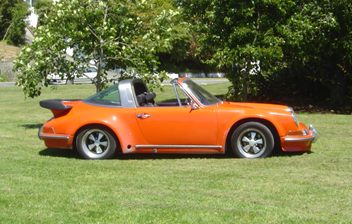
1969 Porsche 911 T Targa. Fortunately, the simple structure of these cars allows the new owner to replace the ridiculous whale tail and flared arches on this otherwise good looking Targa that has been in the country from new. Prices for early 911s appear to be on a similar path to villas in Kingsland so get on the phone to your banker if you intend to join the bidding which has taken off already.

For: Redeemable.
Against: What were they thinking?
Investment potential: 8/10


1990 Saab 900 Turbo. Of course if you just want wind through your thinning thatch, there are cheaper ways than a Porsche. Old Saabs are being given away as they seem to have little appeal to the cap on backwards set who see them as some sort of funny looking dad's car. Their loss is your gain if you can get a good one for a miserly 2K. Join up with the next road train that you see and give the young folks a laugh.

For. Fast and well made by unsmiling Swedish people.
Against: Longer than an XJ6 and four cylinders.
Investment potential: Not high but not much further to go.


1970 Ford Capri 1600 GT XL. Original one owner Ford Capris are likely to start a bidding frenzy as most have had the three Rs * forced well up them by now. The red interior is a delight and I well recall my feelings of hurt and bewilderment that my father did not buy one of these instead of the 1300 Escort XL that was his first new car in 1971. * is raced, rallied and rolled for any reader under the age of thirty who may be reading this blog by accident.

For: Attractive in a North Shore sort of way.
Against: The earth will not move under you.
Investment potential: 6/10


1974  Ferrari 308 GT4. Long stuck at the far end of the Ferrari dog box, it seems that the market has finally decided to forgive the 308 for replacing the Dino. If there had been any sense at all in Maranello they would have thought more like Porsche and still be making the earlier car now. Apart from the looks, the 308 was better in every way and so is like a 928, eminently capable but unwanted. That taken into account, you will not see a Ferrari for 9K.

For: It is a Ferrari.
Against: 54K and needing a repaint...
Investment potential: 3/10 with caveats.

On some faraway beach


Gogomobil Dart. Designed and constructed by our ingenious friends across the Tasman, the doorless Dart was a clever novelty that did not survive long once people could buy a Mini. Even so, I imagine they would be great fun if you were the sort that had a place by the beach and a sense of humour. I doubt that the kids would want to be seen dead in it so it will just be you putting along with Trini Lopez on the cassette player.

For: Useless.
Against: Again, useless.
Investment potential: 3/10. Possibly more if you electrified it.