Sunday, 28 June 2015

The Aesthete does the rounds

The Aesthete's Fleet. 
 The Lancia sized hole in the collection has still not been filled by the Alfetta GTV although the long suffering proprietor of the garage where it is receiving work has not been able to get it off the hoist for three months. The drive shaft is now in place and the clutch input shaft has new bearings, so removing any eccentricity  between the rear mounted gearbox and the bits that make it rotate. Will it work? As they used to say at the end of the TV show Soap, "These questions—and many others—will be answered in the next episode of..."


1947 Studebaker Champion.  Almost all models from the other big American makers were rehashed from the 1930s, leaving Studebaker as the sole provider of a modern  car in the immediate post-war period. Oddly enough, this earlier iteration of Raymond Loewy's Studebaker saloon looks more modern than the later rocket nose cone restyle due to the balanced relationship between the low horizontal grill and the rest of the car. The reverse hung rear door add a touch of glamour to proceedings.

For: I see the car but also girls in nice frocks and Californian modern houses.
Against: The vendor shows us that the doors open and close but won't let us look inside.
Investment potential: 5/10. It is cheap if it is any good.


1960 Daimler Dart. Mason's black suits the idiosyncratic lines of Daimler's quality sports car that looks its best in sober colours. Styled at Hooper where the usual run of work was huge imperial limousines, the combination of upright screen and shaped wings recalled the larger Daimler cars that wore these features more elegantly. None the less, there is a coach-built quality about them that works well with Edward Turner's superb V8.

For: Makes a Triumph TR seem like a dray.
Against: The looks, mainly.
Investment potential: 3/10: Jay Leno owns one and loves it so 45K seems reasonable.


1984 Rover SD1 Vitesse. Don't let the automatic gearbox put you off as the Vitesse is still a very quick car capable of seeing off many pretenders to its touring car crown. This is not the track burning twin plenum engined variety, however, a detail the vendor cleverly skirts. Even so, a well cared for SD1 is a good asset for the garage in whatever form.

For: Smooth, simple and fast.
Against: Old people will tell you "I had a four cylinder diesel one of them. Terrible it was."
Investment potential: 3/10 as that cohort of owners pass on.


1995 Maserati Ghibli. That wiley old Argentinian Alessandro de Tomaso certainly squeezed plenty of value out of the Biturbo platform, letting Maserati's engineers refine it until it was a respectable high speed touring car. In Ghibli form with a restyle by Marcello Gandini, it was ideal for those who thought an M series BMW was just too obvious. Earlier Ghiblis are now seriously expensive so this is a sensible alternative to the 100K restoration project that featured briefly on Trademe this week.

For: Most bad traits of the earlier cars are gone by this point.
Against: "Sensible alternative" to what, exactly? Being dragged behind a hillbilly's pick up?
Investment potential: 3/10. They cannot loose much more value.


1958 Mercedes 190B. I list this on the recommendation of the other well known aesthete, now resident on diplomat's row in the capital and loudly ruing the sale of his Daimler Majestic. He avers that the Mercedes would be an acceptable substitute although it would not see Smart owners fleeing for the safety of the footpath like that old battle cruiser did.

For: If you can whistle the Horst-Wessel-leid you will probably understand.
Against: Buy a 3.5 Litre Rover. You know you want to.
Investment potential: 2/10 but still nice to own.

On some faraway beach


1967 Ghia 450SS. You may recall I showed you a wreck of a Dual Ghia a few weeks ago but here is a later example of the same formula of Italian carrosserie styling on a robust Chrysler frame. Designed by Giorgetto Giugiaro during a brief spell at Ghia, it wears it great bulk well. Poised on expensive Borrani wire wheels that would leave interesting patterns on the road with the torque from the V8, it must still be the ultimate value in Italo-American hybrids.

For: About one tenth the price of a Ferrari Superamerica.
Against: It is up to you if you want to pay 200K for every extra cylinder.
 Who knows what it will sell for but it is very usable.


Saturday, 20 June 2015

The Aesthete reflects on selling old cars

The Aesthete's Fleet
The Lancia Flavia 1800 Coupe proved to be the easiest car to sell but was also the most difficult to own, causing the Aesthete a certain degree of cognitive dissonance. Difficult as there are only a few in the country and consequently few other owners to share hard luck stories with. One Christchurch reader sent a tip to a previous owner of my car who was very happy to be reunited with it. And so it was sold on the Monday following the blog issue. I seem to be more successful selling my own cars than persuading others to buy my recommendations so perhaps I am following the wrong path. If anyone has anything rare, interesting and difficult that they wish to part with, I am prepared to offer space on the blog for a modest brokering fee. 
The Lancia reunited with its earlier Christchurch owner.


1979 Citroen FAF. The intriguing acronym stands for facile à fabriquer (easy to build) and facile à financer (easy to fund) and was a French solution for getting the third world into vehicle ownership. Intended for the crudest of production facilities, the bodies were shaped with a sheet metal former and brush painted. Load carrying was restricted by the 600cc 2CV power plant and it says much about the economic condition of New Zealand under the Muldoon government that one was imported for evaluation to replace the Trekka. If you were wavering, the seductive catalogue image should help you decide.

For: We like a brave failure, don't we?
Against: No-one who does not already own a fleet of derelict 2CVs will understand.
Investment potential: 5/10 as you can fix it with a broken spade handle.


1934 Airflow Chrysler CU. Speaking of brave failures, few attempts to introduce advanced technology to the field of automotive design went as badly awry as the Airflow series. It so frightened Chrysler management that it retreated into deep conservatism that prevailed until the mid-1950s. At the time, however, there were few more modern cars on the road and driving one will permanently change your views on what a 1930s car was capable of. My personal preference is for the coupe version of the smaller De Soto but if you have 85K sitting about unused you could buy yourself a design landmark.

For: The bravest of all brave failures.
Against: A bit cumbersome in 8 cylinder form.
Investment potential: 2/10 with prices still oddly low in the US.


1958 Skoda 440. If you have any cold war fantasies about dashing around Prague in the 1950s with dossiers on the private preferences of senior political figures, here is the car in which you can act out that very role. Bring A Trailer had one listed earlier in the year for £11K so there are others out there who will be the Philby to your McLean.

For: Much better than you might think.
Against: Maybe you needed to be at Oxford in the 1930s.
Investment potential: 9/10. Yes, really. And it will be great fun.


1963 Studebaker Cruiser. The Brooks Stevens restyle of Studebaker's compact Lark range had a strong Lancia like sensibility, enhanced by a properly set out dash and tasteful trim.  The V8 in the top end models allowed decent performance and one feels that they could have given Holden, Ford and Chrysler some trouble in Australasia if the company was not so close to going phut.

For: This was a well studied page in my Observers' Book of Automobiles.
Against: Nothing. This looks like a treat to my eye.
Investment potential: 3/10 but not needing a lot to finish.


1950 Jaguar 3 1/2 Litre Drop Head Coupe.  This has been on the market for a few weeks now so the tendency has been to skip past it in the knowledge that it will probably be there when the next bog needs to be formulated. Is 108K too much? Probably here in New Zealand, yes, but elsewhere? Remember that it costs as much to ship something good as it does a valueless heap.

For: Handsome.
Against: Do people think of these as a spiv's car anymore? Does anyone know what a spiv is?
Investment potential: 2/10 but not around these parts.


On some faraway beach.


1965 BMW 3200CS. I urge you to drink in the details of this superb BMW which was the last of the truly bespoke grand tourers built around the 1950s V8 mechanicals from the odd looking saloon they called the Baroque Angel. The awkward drop nosed predecessor was a hard sell so this version was restyled by a young Giorgetto Giugiaro while at Bertone. Consequently it looks like a big Alfa, an impression carried through to the interior.

For: I know its expensive but look at it.
Against: A Maserati would be more usable.
Investment potential: 3/10. If it were Italian it would be five times the price.


Sunday, 14 June 2015

The Aesthete sells up

The Aesthete's Fleet
The effort of maintaining three old Italian cars is beginning to take its toll and this may be the right time to consider retrenchment. I should not sell the 1750 GTV that I have owned since 1984 as I would be unable to replace it with anything as good. It has become somewhat integral to my life and I will persist with that one until the end of fossil fuel. The Alfetta GTV was purchased cheaply but with a solemn promise to the old owner that I would not immediately flip fit or a profit ... as if anyone could with one of those. That leaves...


1963 Lancia Flavia 1800. This car was imported into New Zealand in 1966 and was in use around Auckland until the late 1980s when it was taken off the road for restoration. It was passed on as a project car to owners in Christchurch and Dunedin and I acquired in 2008. It has a rebuilt engine and all other mechanical systems attended to. It has been repainted and trimmed in synthetic suede. It is surprisingly reliable and has covered around 12,000 kms since returning to full use. I have taken it to the West Coast on the Latins on the Lake rally and to Queenstown with the Alfa club. It is difficult to know what it is worth as there are five in New Zealand and only two on the road. I will sell it for 12K which is the value of a condition 2 car in the UK.

For: Elegant and usable Pininfarina coupe.
Against: Clunks into second gear and some whine from the diff. Rust blister in the driver's door.
Investment potential: Oh, I don't know. Reasonable.


1937 Singer Bantam. A superior small car in the 9hp range, the Bantam was well equipped and quicker than the side valve competition from the larger makers and was able to reach 60 mph. They sold surprisingly well in Australia and New Zealand although the vendor says there are only 50 left operating in the world.  If you need to commute in Aukland do you really need anything faster than this? Answers please.

For: You may think you want an Austin Seven but you actually want one of these.
Against: Get handy with the grease gun and change the oil every 500 miles.
Investment potential: 3/10.


1955 Jaguar XK140 DHC. The most desirable of all the 1950s sporting Jaguars, the DHC versions had fully equipped interiors with burr walnut and leather everywhere and a proper lined hood for flap free motoring in all weathers. This makes them rather expensive to restore and this one is offered in a half finished state. The photographs do not help so caveat emptor.

For: One of these used to park outside the Auckland City Council tower block when the Aesthete was a susceptible adolescent. I wonder if this is it?
Against: 54K is rather a lot when you consider what else may be in store for the owner.
Investment potential. 1/10. You could probably spend another 50K and just break even.


1980 Volvo 242 GT. A blog reader drew my attention to this and I realised guiltily that I had scooted past it on the lookout for more attractive cars to put before you all. They are not meant to seduce you with their wiles but rather reveal their charms more slowly, after a decent long courtship. Of course, they were hot to trot on the race track.

For: Like clog dancing, it is probably fun when you try it.
Against: Not much at all.
Investment potential: 3/10 and no jokes about concrete blocks please.


1962 Chrysler Imperial Crown Coupe. In the battle of the super-behemoths, Chrysler pulled a number of entertaining tricks out of the bag including free standing headlights, asymmetrical seating and moulded spare wheel covers amongst other unpardonable features. This makes them more interesting to look at than Lincolns and Cadillacs but it depends if your delicate optic nerves can take it.

For. Well it is here and you can see it before you buy.
Against: Oh God. It  is soooo ugly.
Investment potential: 0/10 along with all its ilk.


On some faraway beach


1957 Dual Ghia. Of course, if Chrysler wanted to know what its cars would look like in the future, they would send out a chassis to Turin and see what came back. The coach maker Dual used one to enter the luxury car market and these bespoke Ghia bodied boulevardiers sold in tiny numbers to movie stars and South American despots. For the enormous asking price we at least deserve some decent pictures but the old boy standing on the rainy forecourt suggests the whole thing is real.

For: If it was a Ferrari you would be all over it.
Against: Well it's not a Ferrari is it?
Investment potential: You will need  nerve to see this through.


Monday, 8 June 2015

The Aesthete hits a double century

Yes, this is something of a landmark in the history of the blog which now has accumulated two hundred posts, meaning that over one thousand cars have fallen under the Aesthete's basilisk gaze. To the best of my knowledge, only one car has been purchased as a direct consequence of a buyer reading the blog so it is all exquisitely free of all purpose and meaning. Liberated by this knowledge, he can say whatever he wants. True freedom of speech can only exist if nobody is listening so he cheerfully works towards that goal.

1999 Porsche Carrera Cabriolet. In my view, a good car can only be made better by having the roof taken off, if just so people can see your superior smirk before throwing something at you. This black on black Porsche is from the in-between era where the numbers get confusing and only tragic Porsche  aficionados can identify which version to buy. This one has things like new style heads with four valves per cylinder, VarioCam variable valve timing, coil-on-plug ignition and will run out to 165 miles per hour if that makes any difference.

For: That sounds quite enough for 43K. What else do you want?
Against: Only some Porsches are appreciating. Is this one?
Investment potential: Probably not.


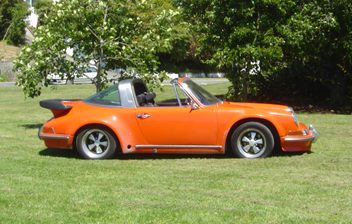
1969 Porsche 911 T Targa. Fortunately, the simple structure of these cars allows the new owner to replace the ridiculous whale tail and flared arches on this otherwise good looking Targa that has been in the country from new. Prices for early 911s appear to be on a similar path to villas in Kingsland so get on the phone to your banker if you intend to join the bidding which has taken off already.

For: Redeemable.
Against: What were they thinking?
Investment potential: 8/10


1990 Saab 900 Turbo. Of course if you just want wind through your thinning thatch, there are cheaper ways than a Porsche. Old Saabs are being given away as they seem to have little appeal to the cap on backwards set who see them as some sort of funny looking dad's car. Their loss is your gain if you can get a good one for a miserly 2K. Join up with the next road train that you see and give the young folks a laugh.

For. Fast and well made by unsmiling Swedish people.
Against: Longer than an XJ6 and four cylinders.
Investment potential: Not high but not much further to go.


1970 Ford Capri 1600 GT XL. Original one owner Ford Capris are likely to start a bidding frenzy as most have had the three Rs * forced well up them by now. The red interior is a delight and I well recall my feelings of hurt and bewilderment that my father did not buy one of these instead of the 1300 Escort XL that was his first new car in 1971. * is raced, rallied and rolled for any reader under the age of thirty who may be reading this blog by accident.

For: Attractive in a North Shore sort of way.
Against: The earth will not move under you.
Investment potential: 6/10


1974  Ferrari 308 GT4. Long stuck at the far end of the Ferrari dog box, it seems that the market has finally decided to forgive the 308 for replacing the Dino. If there had been any sense at all in Maranello they would have thought more like Porsche and still be making the earlier car now. Apart from the looks, the 308 was better in every way and so is like a 928, eminently capable but unwanted. That taken into account, you will not see a Ferrari for 9K.

For: It is a Ferrari.
Against: 54K and needing a repaint...
Investment potential: 3/10 with caveats.

On some faraway beach


Gogomobil Dart. Designed and constructed by our ingenious friends across the Tasman, the doorless Dart was a clever novelty that did not survive long once people could buy a Mini. Even so, I imagine they would be great fun if you were the sort that had a place by the beach and a sense of humour. I doubt that the kids would want to be seen dead in it so it will just be you putting along with Trini Lopez on the cassette player.

For: Useless.
Against: Again, useless.
Investment potential: 3/10. Possibly more if you electrified it.


Sunday, 31 May 2015

The Aesthete's suggestions for a winter project

Anonymous, that ever vigilant defender of orthographical correctness, picked up my spelling of Packard last week. The Aesthete's school reports describe an indolent and easily distracted child, rather too fond of his own opinions. These qualities have been extended and refined in adult life so the blog is often written late at night from his bed, a sight that no reader should try and bring to mind. 


1964 Renault Dauphine. As you all probably know now, the Aesthete is polymorphously perverse in his automotive tastes so let us see how many of his fetishes are served by this little Gallic treat. One: engine at the wrong end. Two: primrose yellow. Three: unmanly. Four: red interior. Five: subtly re-engineered. Oh my God. I need a cold bath and a strong dose of bismuth.

For: Is that not enough?
Against: Not much that is obvious to me.
Investment potential: 5/10 and cheap to run.


1937 Citroen 11CL Light Fifteen: The Aesthete has been known to make silly and ill informed comments about old Citroens but admits that early examples are intriguing. In the mid-1930s they were truly extraordinary and the narrow hulled Michelin Pilote-wheeled cars are a rare thing unto themselves. This Slough-built  car has the creature comforts that the English demanded rather than the industriel steel and cloth of the French versions. It looks like a lot of work but of a rewarding sort.

For: Produced for one year only in this version.
Against: déshabillé.
Investment potential: 2/10 and make sure you can do some of it yourself.


1965 Sunbeam Alpine GT. The GT was the budget model in the Rootes sporting lineup with a removable steel hardtop only. Never mind as the steel wheels and crisp lines complement each other well and the shell looks straight and strong on this unrestored example. The Aesthete's advice is to invest in a modest repaint and leave the rest of it alone. There are too many boiled sweet Alpines already without any of you adding another one.

For: Nice and plain.
Against: You can't have it if you are going to spoil it.
Investment potential: 3/10 but only if you follow the rules outlined above.


1972 BMW 3.0 Si. Mercedes had a lot to learn from BMW whose big sedans were both more sporting and more luxurious than the Dusseldorf taxi. The negative side is all of that expensive bouclé cloth and solid wood deteriorates over time, leaving the interiors looking as if a wolf pack has been in residence. This one looks at least presentable, leaving an undiagnosed engine problem as the sticking point. Sort that out and you will own one of the best cars of its era.

For: Smooth, fast and elegant.
Against: Sickly six cylinder BMW engines are nothing trivial.
Investment potential: 3/10 if it is an easy fix.


1968 Austin Princess: Proposed as a small Bentley, the Princess was a clever repackaging of a lowly Austin but loaded with a Rolls Royce military engine that whomped out a rather impressive 145 horsepower. No doubt this generous reserve of performance was never used to the full and most went from public service to mature owners who pottered around with them. This one probably hauled Ratu Sir Kamisese Mara around in Fiji so may appeal to old colonial era snobs out there. You know who you are.

For: Better than it needed to be.
Against: 145 bhp in a Westminster...
 2/10 as long as you get it running and spend no further money on it.

On some faraway beach...


1951 Jowett Jupiter. Back in Blighty at a time when unorthodoxy was a serious offence, getting the Austrian designer of the Tiger tank and V2 rocket to author your sports car carried a certain risk. Robert Eberan von Eberhorst's space framed Jupiter was companion to the brilliant Javelin saloon, the only British post war family car that had anything to say in terms of innovation.  To justify the gawky looks, compare it to a MG TC.

For: Genius.
Against: People have forgotten who Noddy was but they may still say unkind things.
Investment potential: 5/10. Aluminium body, small engine, race pedigree.


Saturday, 23 May 2015

The Aesthete sees the end coming

The Aesthete's Fleet
 That Jeremiah J. Clarkson believes the world is losing interest in cars due to the fact that most new ones are inherently uninteresting and young people are not sitting their driver's test and prefer getting carted around by bus. Was it not always so? Could anyone who bought a Morris Marina be said to like cars? It did strike me at the Rally of Otago that many of the competitors might have looked more comfortable on the sofa but they were out there getting their sciatic nerves pinched and covering spectators with dust and stones. Apart from that, old people have far more money and time than granted to the young, two factors that remain necessary for classic car ownership. Hasten the male menopause and superannuation then.


1955 Packard Clipper Coupe. Packards were thought of as stodgy but all the Aesthete sees is patrician elegance, a quality suppressed in most American cars of the period. The single deep blue hue of this Clipper shows its handsome details in high relief and one could see it pulling up to the doors of the Monaco Casino in period without raising a smirk from anyone.  If you are tempted to take it to the beach hop, keep your distance from the others and maintain your standards.

For: A proper American.
Against: The vendor has been caught out somehow. Find out how.
Investment potential: 4/10 if you can have it for 15K.


1959 Jaguar 2.4 Litre Saloon. This phase of Jaguar's first unit bodied saloon saw handling and braking improvements that meant its performance could be used properly and they were the car of choice for a generation of professional drivers. The simple cabin details hark back to a period when a cigar lighter was a luxury feature but I guarantee that you could still drive one of these all day and not feel like you had been put on the rack.

For: When Harold McMillan told the British public that they had never had it so good, I believe he was talking about this car.
Against: Train robbers liked them too.
Investment potential: 8/10. I would grab this one and the grey automatic and get them to the UK quick smart.


1967 Audi 75. This would have earned good spotting points in my Observers Book of Automobiles,  filled out by the junior Aesthete while his parents drove the countryside looking for a pub. I recall a small number of these plush little German cars, usually with continental owners driving them carefully in case anything broke. This one fits the pattern so if you desire a well engineered and perky alternative to a BMW, here it is.

For: An Audi or an Oxford. Well, what would you do?
Against: Don't break anything. Nothing much has changed on that score over the past fifty years.
Investment potential: 2/10. They will never be worth a fortune.


1977 Panther Lima. The Panther Lima was no kit car but more of a Lotusey sort of thing with decent creature comforts and enough performance to scare the wits out of driver and miserable passenger. Powered by the 2.3 Vauxhall OHC motor from a Victor, there was torque and horsepower in a light package with turbo variants capable of 150 mph. Let us salute them then, those who go out on wet days in a Panther Lima.

For: They may laugh at your funny little car until you give it the gas.
Against: Make sure you have plenty of room on the road.
Investment potential: 1/10. Not much room to move at 30K it has to be said.


 1971 Toyota Crown Hardtop Coupe. The Aesthete guiltily savours the period where the Japanese stopped asking Italians to style their cars and began doing it for themselves. This Crown startled the senses with a raised bonnet intake sweeping across the wings to take in the side lights and flush body coloured bumpers. A number of these were shipped down to New Zealand where we seemed to be immune from aesthetic trauma. This will go in a flash, I predict.

For: Not like Italian ugly/beautiful. Just ugly.
Against: Its like an Alfa Romeo painted by Roger Bacon then.
Investment potential: 5/10. Ironic cars are the only way to please the coming generation of hipsters. Buy now or miss out.

On some faraway beach...


1958 Ford 10 Special. Not that faraway at all really but worth our attention anyway. This special bodied Ford looks like it deserves finishing and it would be a treat to see on the track, if other owners would come forward with theirs and make a day of it. It needs a few things but it would give you an excuse to attend swap meets instead of cutting the hedge. Now is that not a better use of your time?

For: Ching-designed according to the vendor. Tell me more about this Ching.
Against: A bit too old school for you is it?
Investment potential: 3/10 but make sure you finish it.


Sunday, 17 May 2015

The Aesthete surveys the Trademe ruins

The fleet has been parked up for the winter so there are no hard luck stories to relate this week. To assuage my boredom, the Aesthetette got me An English Affair by Richard Davenport -Hines, a splendid analysis of the Profumo affair. It made me realise that the mores of upper class London in the 1960s were effectively carried over to Glenfield in the following decade and that I was not imagining the nude spa pool parties that my parents took me to when I was a wide eyed adolescent.


Lancia Delta HF Turbo i.e. That random tangle of words and letters is like fine poetry for keen drivers but without the demanding nature of the more powerful EVO cars. A good example will see off most German and Japanese challengers and possess a jiggling Latin vitality that is an invitation to wring its neck even when going to the shops for cat food and milk.

For: Guaranteed to bring some excitement to your tepid existence.
Against: You will need mambo dancers' hips to be comfortable in the Recaro seats.
Investment potential: 5/10 as the last viable ones come to the market.


1988 Peugeot 205 GTI. Note that I only mentioned German and Japanese models and handily swerved around the impressive 205 which in 1.9 litre form was almost indomitable. Italianate in both form and character, it set an impressive standard for factory built GTs that required little further specialist attention before taking to track or gravel.

For: The belle époque for quick hatches.
Against: The dad's car profile of the rest of the range.
Investment potential: 6/10 and climbing.


Renault 4CV. Renault's clever response to reconstruction was supposedly penned in secret during the war with production starting in 1947. It stole a handy march on the Morris Minor so it you wanted a small modern car before the end of the decade, the 4CV was the principal contender. They are enjoyable to drive, simple to fix and full of Gallic charms, even when built in England as this one was. 

For: R10 engine transplants answer the performance issues.
Against: Nozzing.
Investment potential: 4/10. It looks solid under the scruffy paint which is important with these early monocoque cars.


1965 Commer PA Auto-Sleeper camper. English-built campers have always held strong attraction to the Aesthete since he was captivated by a be-finned Bedford CA Dormobile in the 1970s. This one looks like it was fitted out by one of the better makers with a tasteful oak ply cabin in the contemporary G-Plan manner. Save yourself 40K on a Kombi and buy this.

For: Whatever happened to empire loyalty? Show some patriotism there, man.
Against: A rummage in the parts bucket with bits of Sunbeam Talbot and Minx promiscuously mixed through.
Investment potential:2/10 as it needs a bit more work yet.


TVR Cerbera. The ultimate hoodlum's runabout, the Cerberra reestablished TVR as a super car brand that offered lunatic levels of performance in a cut price package. Even the six cylinder cars could manage 170 mph although most drivers chose continued life over the uncertain prospects on offer at that speed. To manage that, some V8 models had a button on the dash that switched off the driver's judgement. 

For: Something for the eight year old that lives in all of us.
Against: We don't let them drive for good reason.
Investment potential. Akin to heroin I suspect.

On some faraway beach...


1963 Rochdale Olympic. Not merely another oddball torn from the back pages of Autocar, circa 1960, the Rochdale Olympic was an accomplished monocoque glass fibre package designed to take a B-series or Ford engine. Light weight ensured well over 100 mph in either form and this improved Mk 2 made has an opening rear hatch. 

For: Yes, it needs improvements but these are ideal candidates for a project. All the body moulds are retained by the UK Rochdale club.
Against: I like it. That should be warning enough.
Investment potential: 3/10. Cheap and no bids come in.